Principle 9 Blueprint: Empower Execution & Drive Change - Execution Intelligence

Updated: Nov 13
Embrace autonomy within the guardrails. Track every investment. Drive change across the organization.
Approving the right investments doesn't deliver value. Executing them well does. Most organizations already have project managers, PMOs, and delivery methodologies, and they still lose enormous value between the decision and the result. The evidence of what's going wrong exists. It rarely becomes something anyone can act on in time. At StrategyXF, Principle 9 exists to close that gap, turning evidence into execution intelligence that reaches the right person while there's still time to act. This is the official Principle Blueprint for Principle 9, the StrategyXF standard for what empowering execution requires, and what achieving it looks like.
This Principle Blueprint is StrategyXF's official standard, defined and continuously refined through open review by the multi-disciplinary leaders and practitioners of The Strategy eXecution Forum. New to the discipline? Start with what strategy execution really means.
What is execution intelligence?
Execution intelligence is evidence of what's going wrong — or right — that reaches the right person while there's still time to act. Most organizations already have project managers, PMOs, and delivery methodologies, yet that evidence rarely becomes something anyone can act on in time, and portfolio decisions run on stale evidence. Principle 9 is the StrategyXF standard for closing that gap, as one of the 10 Key Principles of Strategy Execution. It sits inside the wider discipline of strategy execution.
StrateX Playbook: Principle 9 Blueprint: Empower Execution & Drive Change
Already a member? Read the full BluePrint

Not a member? Apply to become a member
What's inside this Blueprint
Every Principle BluePrint covers six things. Here's what each one found for Principle 9.
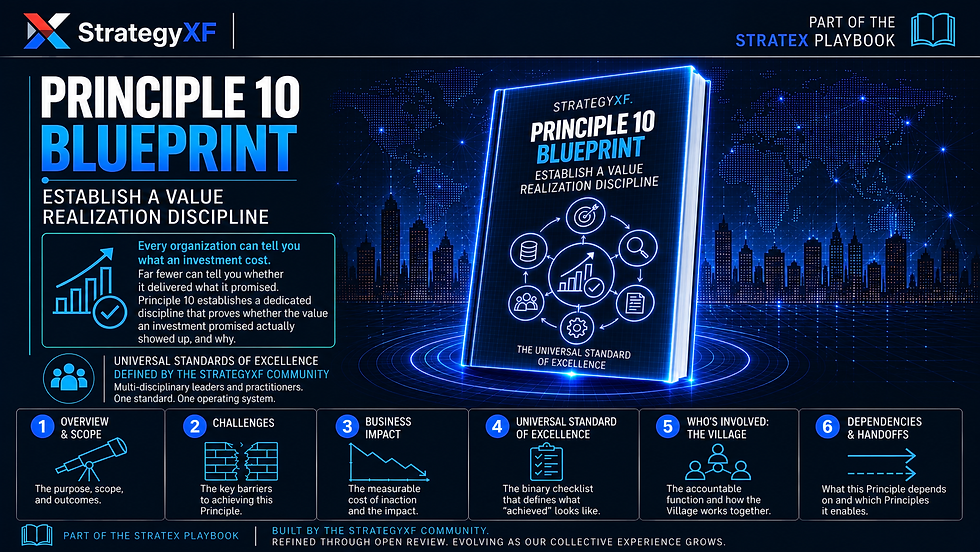
Principle Overview & Scope. Principle 5 captures and qualifies demand. Principle 6 decides what gets funded, rebalanced, and stopped. Principle 9 is where that decision becomes reality. It sets minimum enterprise standards to track every in-flight investment, BAU activity, operational initiatives, and discretionary initiatives alike, while business units and shared services keep the freedom to choose how they plan, deliver, and manage change. Evidence becomes execution intelligence at two levels. Delivery teams act on it within their own authority, and Principle 6 acts on it when an investment's standing is in question. Scope runs through formal handover to operations, so technical completion is never mistaken for the finish line.
Challenges. Setting standards is one thing. Holding every investment to the rigor its nature requires is another. Fifteen challenges stand in the way, from one-size-fits-all methodologies and BAU activity that never gets tracked in a form that fits it, to undocumented dependencies, handovers that happen before the receiving side is ready, status reports that work as a rear-view mirror, and escalations that never happen because raising a problem feels like admitting failure. Some originate in Principle 9's own discipline. Others start upstream and land here as an execution problem. The Blueprint names them all.
Business Impact. Without Principle 9, the organization loses the ability to see whether execution is delivering what strategy intended. Portfolio decisions run on stale evidence. Forecasting of cost, resources, and benefit misdirects capital and capacity. Material change either stalls waiting for a decision or happens without one. And the human cost compounds quietly. Problems get hidden instead of raised, and no one owns the whole.
Universal Standard of Excellence Checklist. Twenty binary outcomes across six areas define exactly what "achieved" looks like, from enterprise standards that preserve execution autonomy, to benefit reforecast by the Investment Owner, to a formal, condition-based handover to operations. No partial credit, no maturity scale to hide behind.
Who's Involved: The Village. Accountability here sits with the Enterprise Strategy Execution Function for the Principle 9 discipline itself, not for any individual investment's outcome. That stays with the Investment Owner. Delivery executes, Change & Enablement assures the change dimension, and the business unit clusters step in directly when they receive the handover. C-Suite and Executive Leadership are kept informed, because the investment decisions are made in Principle 6.
Dependencies & Handoffs. Principle 9 depends on Principles 2 through 8 for the enterprise standards, strategic intent, architecture, execution baseline, funding decisions, financial standards, and resource pool that execution runs on. In return, it feeds execution intelligence and lessons learned back to Principles 2, 4, 5, 6, and 7, and the continuously reforecast benefit expectation to Principle 10. Information flows both ways, while accountability stays where each Principle puts it.
What none of this covers is how. The Plays, the specific methods, tools, and approaches organizations use to achieve each Principle, live separately in the StrateX PlayBook. The Blueprint defines what good looks like. The Plays show you how to get there.
"Principle 5 captures and qualifies demand. Principle 6 decides what gets funded, rebalanced, and stopped. Principle 9 is where that decision becomes reality."From the Principle 9 Blueprint
StrateX Playbook: Principle 9 Blueprint: Empower Execution & Drive Change
Already a member? Read the full BluePrint
Not a member? Apply to become a member
Why StrategyXF is sharing this
StrategyXF exists to elevate Strategy Execution as a C-Suite imperative, an enterprise discipline every organization must proactively develop. Principle 9 is where that discipline meets the day-to-day work. Strategy only creates value when the investments chosen to deliver it are executed well, and most organizations can't see clearly enough to know whether they are. Principles 5 and 6 decide what gets funded. Principle 9 makes sure it gets delivered, and keeps the rest of the system honest about what's actually happening. The Principle BluePrints are how we define what "good" looks like across the entire operating system, one Principle at a time.
This Blueprint is a living standard, not a finished one. Have direct experience tracking execution, managing the handover to operations, or getting bad news to the right decision-maker in time? The Strategy eXecution Forum reviews every BluePrint section by section before it's finalized, and every Principle will continue to evolve as the community's collective experience grows. Reach out if you'd like to take part in an upcoming review.
About this Blueprint
This Principle Blueprint was defined and reviewed by the multi-disciplinary leaders and practitioners of the Strategy eXecution Forum, senior leaders spanning the C-Suite, Strategy & Operations, Transformation Offices, Finance, HR, IT, PMO, Enterprise Risk, Change Management, Portfolio Management, and Business Architecture. Our thanks to everyone in the Forum who challenged assumptions, pressure-tested the thinking, and helped shape this into StrategyXF's official standard. As the community grows, so will this Blueprint.
Join The Strategy eXecution Forum

The Strategy eXecution Forum (StrategyXF) is an invite-only, no-fee professional community built by and for practitioners who understand the challenges of closing the persistent gap between strategy and results. We believe it requires a collective effort to master strategy execution. StrategyXF brings together senior leaders from across the enterprise: C-suite executives, Strategy & Operations leaders, Transformation Offices, Finance, HR, IT, PMO, Enterprise Risk, Change Management, Portfolio Management, Business Architecture, and more.
Together, we collaborate on real-world challenges, share proven approaches, and shape the future of disciplined and impactful organizational execution. This is not a passive network; it is a practitioner-led community where your experience adds real value. Every discussion is designed to deliver practical ideas you can apply immediately. If you are serious about elevating strategy execution as a mission-critical discipline, we invite you to apply to become a member and help us build something the profession has long needed.