Principle 8 Blueprint: Build the Workforce & Culture for Strategy Execution

Build the skills. Align the incentives. Earn the commitment.
Most organizations recruit capable people, design thoughtful incentive plans, and invest heavily in development, and still watch their people pull in different directions. Each piece is well built. Nobody built the connection between those pieces and the strategy they exist to serve. Strategy weakens the further it travels from the C-suite, goals get written locally, and pay rewards the next review cycle instead of the multi-year horizon. At StrategyXF, Principle 8 exists to close that gap, making People & Resources a strategic partner in the Village and building a workforce that understands the strategy, has the skills to deliver it, is rewarded for the right behaviors, and is genuinely committed to making it happen. This is the official Principle Blueprint for Principle 8, the StrategyXF standard for what that requires, and what achieving it looks like.
This Principle Blueprint is StrategyXF's official standard, defined and continuously refined through open review by the multi-disciplinary leaders and practitioners of The Strategy eXecution Forum.
StrateX Playbook: Principle 8 Blueprint: Build the Workforce & Culture for Strategy Execution
Already a member? Read the full BluePrint

Not a member? Apply to become a member
What's inside this Blueprint
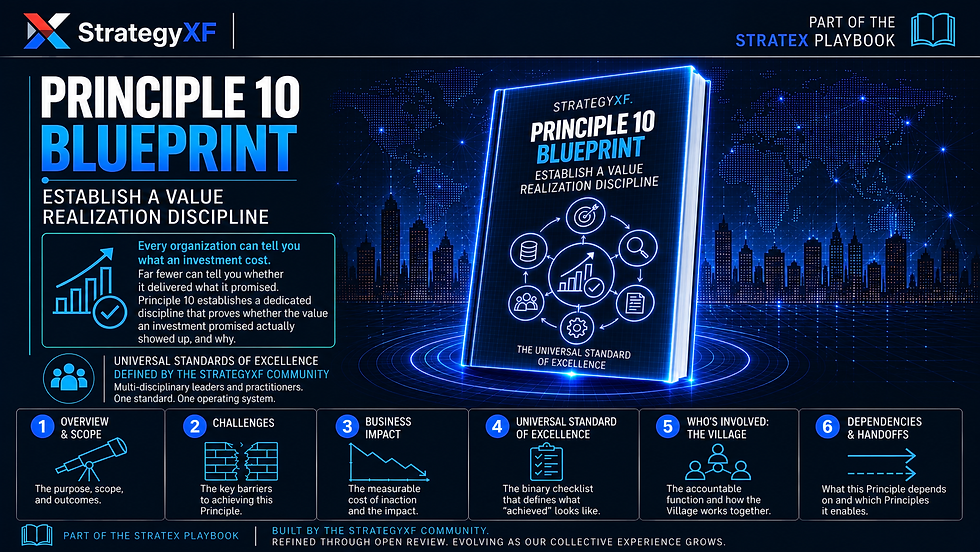
Every Principle BluePrint covers six things. Here's what each one found for Principle 8.
Principle Overview & Scope. Principle 8 is the people and culture layer of the Strategy Execution operating system. It makes People & Resources a strategic partner in the Village, not a downstream function brought in once the system is designed, and it builds a shared understanding of the strategy across the workforce. Four components do the work, a strategy ready resource pool, a workforce optimized for where the strategy is heading, continuous communication with incentives aligned to it, and a culture of strategy execution excellence. It governs the culture of strategy execution, not company-wide culture transformation.
Challenges. Principle 8 asks strategic intent to travel the full distance from the C-suite to the frontline and stay reinforced the whole way. Most organizations already have workforce data, incentive frameworks, and a stated ambition for engagement. What they lack is distance and reinforcement. Eleven predictable barriers stand in the way, from workforce inventories never built for strategy execution, to goals written locally instead of derived from strategy, to incentives that reward the next review cycle over the multi-year horizon, to empowerment that gets withdrawn at the first imperfect outcome.
Business Impact. Without Principle 8, a well designed strategy gets delivered by a workforce that doesn't fully understand it, isn't rewarded for pursuing it, and doesn't have the skills it requires. Incentives keep rewarding the wrong behaviors. Capability gaps surface at the point of delivery failure, when they are most expensive to close. Commitment never displaces compliance, and high performers leave first. Gallup's 2026 State of the Global Workplace found global employee engagement fell to 20 percent in 2025, its lowest level since 2020, and an organization without Principle 8 has nothing working against that trend.
Universal Standard of Excellence Checklist. Fourteen binary outcomes across six areas define exactly what "achieved" looks like, from People & Resources holding a seat in the Village as a strategic partner, to employees across functions talking about strategic outcomes as ours instead of theirs and mine. No partial credit, no maturity scale to hide behind.
Who's Involved, The Village. Principle 8 separates three things. People & Resources is accountable for the workforce, incentive, and culture mechanisms and for showing whether they are working. Leaders are responsible for the behaviors they model and reinforce in their own areas, and the C-Suite, led by the CEO, creates the conditions the enterprise-wide outcomes depend on. The Strategy Execution function is responsible for making sure it happens, starting with embedding People & Resources in the Village as a full member. Accountability for any individual's conduct or performance stays with their line leader.
Dependencies & Handoffs. Principle 8 runs alongside Principle 7 as a parallel, foundational layer and does not wait for the rest of the operating system to be built. It draws on the strategic direction from Principle 3, the operating model from Principle 4, forward demand and the roadmap from Principles 5 and 6, and the value evidence from Principle 10. In return, it hands the standardized resource pool to Principles 4, 5, 6, and 9, and sends the lessons learned from the workforce and culture side back to Principle 2.
What none of this covers is how. The Plays, the specific methods, tools, and approaches organizations use to achieve each Principle, live separately in the StrateX PlayBook. The Blueprint defines what good looks like. The Plays show you how to get there.
"Principle 3 sets the direction. Principle 4 maps what the operating model needs. Principle 8 makes sure the workforce, skilled, incentivized, and committed, is what actually carries it out."From the Principle 8 Blueprint
StrateX Playbook: Principle 8 Blueprint: Build the Workforce & Culture for Strategy Execution
Already a member? Read the full BluePrint
Not a member? Apply to become a member
Why StrategyXF is sharing this
StrategyXF exists to elevate Strategy Execution as a C-Suite imperative, an enterprise discipline every organization must proactively develop. Principle 1 makes the cost of inaction undeniable. Principle 8 is where strategy meets the people who have to deliver it. Every other Principle depends on people to carry it out, and this is the Principle that makes sure they understand it, are equipped for it, are rewarded for it, and believe in it. It is a bridge, and it never stops being built. The Principle BluePrints are how we define what "good" looks like across the entire operating system, one Principle at a time.
This Blueprint is a living standard, not a finished one. Have direct experience building a workforce and culture that executes strategy, or watching an attempt to align incentives to strategy quietly stall? The Strategy eXecution Forum reviews every BluePrint section by section before it's finalized, and every Principle will continue to evolve as the community's collective experience grows. Reach out if you'd like to take part in an upcoming review.
About this Blueprint
This Principle Blueprint was defined and reviewed by the multi-disciplinary leaders and practitioners of the Strategy eXecution Forum, senior leaders spanning the C-Suite, Strategy & Operations, Transformation Offices, Finance, HR, IT, PMO, Enterprise Risk, Change Management, Portfolio Management, and Business Architecture. Our thanks to everyone in the Forum who challenged assumptions, pressure-tested the thinking, and helped shape this into StrategyXF's official standard. As the community grows, so will this Blueprint.
Join The Strategy eXecution Forum

The Strategy eXecution Forum (StrategyXF) is an invite-only, no-fee professional community built by and for practitioners who understand the challenges of closing the persistent gap between strategy and results. We believe it requires a collective effort to master strategy execution. StrategyXF brings together senior leaders from across the enterprise: C-suite executives, Strategy & Operations leaders, Transformation Offices, Finance, HR, IT, PMO, Enterprise Risk, Change Management, Portfolio Management, Business Architecture, and more.
Together, we collaborate on real-world challenges, share proven approaches, and shape the future of disciplined and impactful organizational execution. This is not a passive network; it is a practitioner-led community where your experience adds real value. Every discussion is designed to deliver practical ideas you can apply immediately. If you are serious about elevating strategy execution as a mission-critical discipline, we invite you to apply to become a member and help us build something the profession has long needed.