Principle 6 Blueprint: Principle 6 Blueprint: Continuously Optimize the Strategic Roadmap - Continuous Planning for Strategy Execution

Your portfolio is set once a year. Your market isn't.
Most organizations lock in their investment priorities annually and then defend them for twelve months while competitors move, technology shifts, and regulations change. By the time Principle 6 begins, the organization has everything it needs to get the portfolio right. None of it keeps the portfolio right once conditions change.
At StrategyXF, Principle 6 exists to close that gap, replacing the annual reset with continuous evaluation and rebalancing of every investment, so the strategic roadmap always reflects what matters now. This is the official Principle Blueprint for Principle 6, the StrategyXF standard for what continuous planning for strategy execution requires, and what achieving it looks like.
This Principle Blueprint is StrategyXF's official standard, defined and continuously refined through open review by the multi-disciplinary leaders and practitioners of The Strategy eXecution Forum.
StrateX Playbook: Principle 6 Blueprint: Continuously Optimize the Strategic Roadmap - Continuous Planning for Strategy Execution
Already a member? Read the full BluePrint

Not a member? Apply to become a member
What's inside this Blueprint
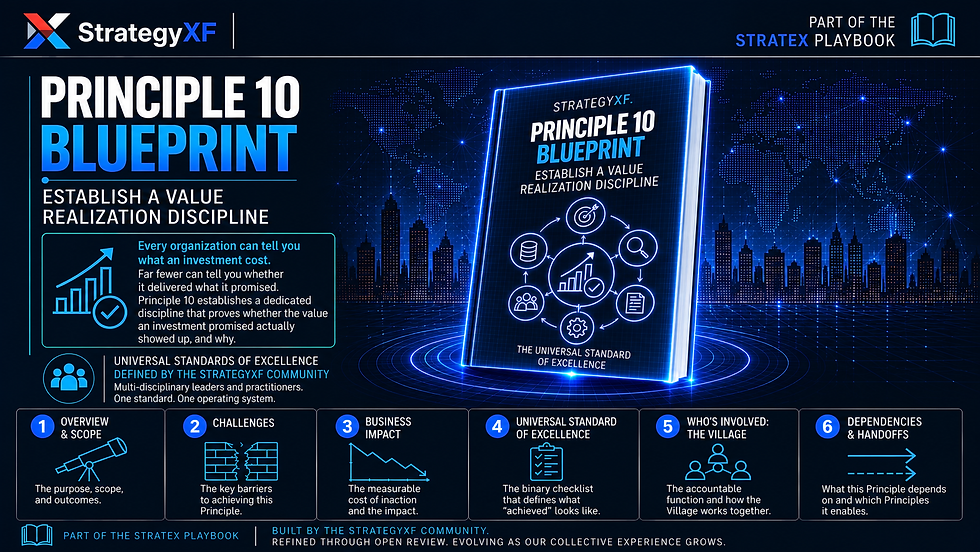
Every Principle Blueprint covers six things. Here's what each one found for Principle 6.
Principle Overview & Scope. Principle 6 is the investment decision layer of the Strategy Execution operating system. It continuously evaluates and rebalances all investment, operational and discretionary, new and already in flight, against one consistent set of criteria. No investment is exempt because it has already started. The Strategy Execution Office sets the enterprise standards and cadence that give a direct line of sight across everything, while business units and shared services keep decision rights over their own investments and choose how they plan and deliver them. The outcome is one living, multi-year roadmap at the level of major investments, not execution detail.
Challenges. The annual cycle, the finance structures behind it, and the politics around investment decisions were all built for stability, not continuous reassessment. Ten distinct barriers follow from that, from a finance function invested in the annual cycle, to incentives that reward optimizing a piece rather than the portfolio, to a roadmap that is hard to aggregate across business units running different delivery models. Then there is the risk on the other side, where rebalancing without a stable strategic core degrades into reactive thrashing.
Business Impact. Without Principle 6, strategy and execution drift apart silently. Research shows a third of companies reallocate only about 1 percent of capital year over year, so money committed once rarely moves, whether or not conditions still justify it. Capital stays locked in work that should have stopped, better opportunities go unfunded, and people lose confidence that their effort is going where it matters. The damage lands in three layers, strategic, operational, and human, and it compounds every cycle.
Universal Standard of Excellence Checklist. Fourteen binary outcomes across four areas define exactly what "achieved" looks like, from a decision-rights framework that preserves business unit autonomy to a living roadmap that surfaces dependencies before they become execution conflicts. Rebalancing decisions must result in actual reallocation, not just approval on paper. No partial credit, no maturity scale to hide behind.
Who's Involved: The Village. Principle 6 engages every cluster of the Village, each with a defined role. The Enterprise Strategy Execution Function is accountable for the standards, cadence, and decision rights, and, jointly with Strategic Portfolio Management, for confirming that decisions actually take effect. Executive Leadership is responsible for the investments in their own organizations, Finance partners with the SEO on the continuous cadence, and business units keep full autonomy to plan and execute within an approved investment.
Dependencies & Handoffs. Principle 6 sits at the center of the operating system. It draws on the mandate, strategic direction, architecture, qualified demand, financial processes, workforce capacity, execution performance, and value data that Principles 2 through 5 and 7 through 10 provide. In turn, Principles 7 through 10 depend on the investment decisions it makes, so for those four the relationship runs both ways. Every Principle before Principle 6 hands it something to decide with. Every Principle after depends on the decision having been made.
What none of this covers is how. The Plays, the specific methods, tools, and approaches organizations use to achieve each Principle, live separately in the StrateX PlayBook. The Blueprint defines what good looks like. The Plays show you how to get there.
"An organization that can only reassess its investments once a year is not a strategically agile organization. It is one that is structurally unable to keep pace with a world that does not wait for its planning calendar."- From the Principle 6 Blueprint
StrateX Playbook: Principle 6 Blueprint: Continuously Optimize the Strategic Roadmap - Continuous Planning for Strategy Execution
Already a member? Read the full BluePrint
Not a member? Apply to become a member
Why StrategyXF is sharing this
StrategyXF exists to elevate Strategy Execution as a C-Suite imperative, an enterprise discipline every organization must proactively develop. Principle 6 is where that discipline shows up in the decisions an organization actually makes, because it is the point where strategy turns into investment. The Principle BluePrints are how we define what "good" looks like across the entire operating system, one Principle at a time.
This Blueprint is a living standard, not a finished one. Have direct experience moving your organization from annual planning to continuous rebalancing? The Strategy eXecution Forum reviews every BluePrint section by section before it's finalized, and every Principle will continue to evolve as the community's collective experience grows. Reach out if you'd like to take part in an upcoming review.
About this Blueprint
This Principle Blueprint was defined and reviewed by the multi-disciplinary leaders and practitioners of the Strategy eXecution Forum, senior leaders spanning the C-Suite, Strategy & Operations, Transformation Offices, Finance, HR, IT, PMO, Enterprise Risk, Change Management, Portfolio Management, and Business Architecture. Our thanks to everyone in the Forum who challenged assumptions, pressure-tested the thinking, and helped shape this into StrategyXF's official standard. As the community grows, so will this Blueprint.
Join The Strategy eXecution Forum

The Strategy eXecution Forum (StrategyXF) is an invite-only, no-fee professional community built by and for practitioners who understand the challenges of closing the persistent gap between strategy and results. We believe it requires a collective effort to master strategy execution. StrategyXF brings together senior leaders from across the enterprise: C-suite executives, Strategy & Operations leaders, Transformation Offices, Finance, HR, IT, PMO, Enterprise Risk, Change Management, Portfolio Management, Business Architecture, and more.
Together, we collaborate on real-world challenges, share proven approaches, and shape the future of disciplined and impactful organizational execution. This is not a passive network; it is a practitioner-led community where your experience adds real value. Every discussion is designed to deliver practical ideas you can apply immediately. If you are serious about elevating strategy execution as a mission-critical discipline, we invite you to apply to become a member and help us build something the profession has long needed.