Principle 5 Blueprint: Capture & Qualify All Demand - Demand Management Strategy Execution

Updated: Sep 22
Capture the right information consistently — so every investment can be confidently evaluated.
Most organizations can tell you what they're working on. Very few can tell you everything they're working on. Discretionary projects get tracked. The operational work consuming most of the organization's capacity, the risk obligations nobody wants to fund, the demand routed informally to protect a budget, none of it shows up in the same place. StrategyXF research indicates this misalignment leaves as much as 26% of potential value on the table, and it starts here, before a single investment decision gets made.
At StrategyXF, Principle 5 exists to close that gap, consolidating and qualifying all organizational demand into a single enterprise view leadership can trust. This is the official Principle Blueprint for Principle 5, the StrategyXF standard for what capturing and qualifying all demand requires, and what achieving it looks like.
This Principle Blueprint is StrategyXF's official standard, defined and continuously refined through open review by the multi-disciplinary leaders and practitioners of The Strategy eXecution Forum.
StrateX Playbook: Principle 5 Blueprint: Capture & Qualify All Demand - Demand Management Strategy Execution
Already a member? Read the full BluePrint

Not a member? Apply to become a member
What's inside this BluePrint
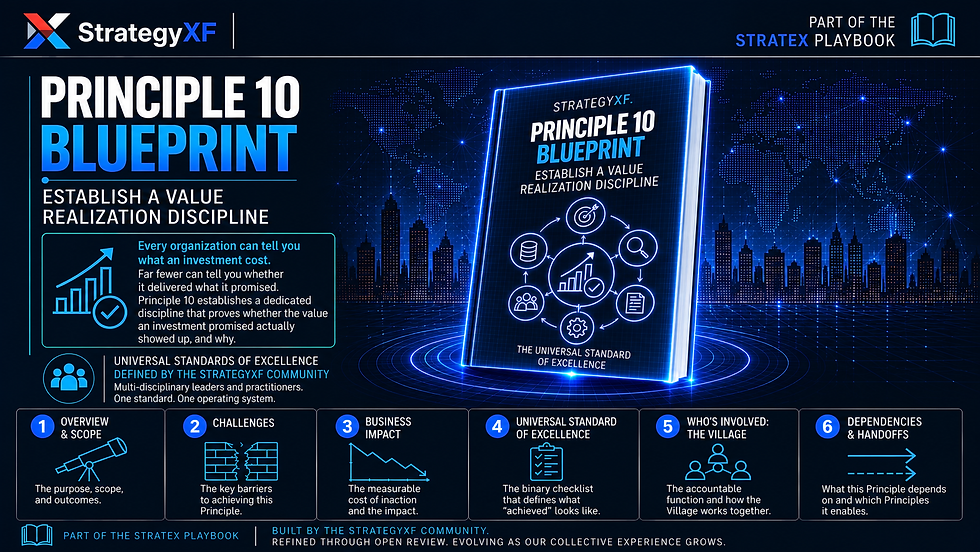
Every Principle BluePrint covers six things. Here's what each one found for Principle 5.
Principle Overview & Scope. Demand doesn't need collecting so much as connecting. Principle 3 and Principle 4 already generate the core strategic and architectural pipelines. Principle 5 exists for everything else, the regulatory obligations, the operational commitments, and the emergent requests that surface throughout the year outside the original planning cycle. It consolidates all of it into one enterprise view, then holds it to a consistent minimum standard before it moves forward. Principle 5 doesn't decide what's worthy of investment. That's Principle 6's job. It decides what's ready to be evaluated.
Challenges. Eight distinct barriers stand between most organizations and Principle 5, and they trace back to one root cause. Visibility creates accountability, and leaders who have built influence managing their own priorities informally have little incentive to give it up. Governance built to catch misaligned demand becomes the obstacle to managing well-derived demand. Operational and risk-driven work stays invisible while it consumes most of the organization's capacity. The barriers here are as political as they are structural.
Business Impact. Without Principle 5, the top-down pipelines Principle 3 and Principle 4 establish compete on an uneven playing field. Strategic initiatives lose to demand that is simply louder or more polished, execution capacity gets systematically overestimated, and risk-driven investments get quietly deprioritized until the exposure they were meant to prevent becomes real. That 26% figure compounds with every planning cycle it goes unaddressed.
Universal Standard of Excellence Checklist. Eighteen binary outcomes across six areas define exactly what "achieved" looks like, from strategic demand derived directly from Principle 3's objectives to informal and shadow demand channels identified and minimized. No partial credit, no maturity scale to hide behind.
Who's Involved: The Village. Rather than a task-level RACI, this section maps engagement at the cluster level, so it holds across organizations whose role titles and reporting lines differ. All four Village groups and thirteen clusters are covered, from the Enterprise Strategy Execution Function, which is Accountable for setting the minimum enterprise standards, through to the business units and shared services actually originating demand. Organizations map their own teams onto these clusters, then build the detailed, activity-level RACI within the Play they adopt.
Dependencies & Handoffs. Principle 5 depends on Principles 1 through 4 for the mandate, the enterprise function, and the top-down demand pipelines that make consistent capture possible. It's the direct enabler of Principles 6 through 10, every one of which depends on the qualified demand picture Principle 5 produces. It isn't a one-way handoff. The quality of what enters Principle 5 determines the quality of what leaves it, and the quality of what leaves it determines the quality of everything that follows.
"The quality of what enters Principle 5 determines the quality of what leaves it. And the quality of what leaves it determines the quality of everything that follows." — From the Principle 5 Blueprint
StrateX Playbook: Principle 5 Blueprint: Capture & Qualify All Demand - Demand Management Strategy Execution
Already a member? Read the full BluePrint
Not a member? Apply to become a member
Why StrategyXF is sharing this
StrategyXF exists to elevate Strategy Execution as a C-Suite imperative, an enterprise discipline every organization must proactively develop. Principle 1 makes the cost of inaction undeniable. The Principle BluePrints are how we define what "good" looks like across the entire operating system, one Principle at a time, and Principle 5 is where the organization's demand picture either becomes trustworthy or stays fragmented.
This Blueprint is a living standard, not a finished one. Have direct experience managing demand, whether that's fighting for visibility into operational work, building qualification standards, or trying to get informal demand into a formal pipeline? The Strategy eXecution Forum reviews every BluePrint section by section before it's finalized, and every Principle will continue to evolve as the community's collective experience grows. Reach out if you'd like to take part in an upcoming review.
About this BluePrint
This Principle Blueprint was defined and reviewed by the multi-disciplinary leaders and practitioners of the Strategy eXecution Forum, senior leaders spanning the C-Suite, Strategy & Operations, Transformation Offices, Finance, HR, IT, PMO, Enterprise Risk, Change Management, Portfolio Management, and Business Architecture. Our thanks to everyone in the Forum who challenged assumptions, pressure-tested the thinking, and helped shape this into StrategyXF's official standard. As the community grows, so will this Blueprint.
Join The Strategy eXecution Forum

The Strategy eXecution Forum (StrategyXF) is an invite-only, no-fee professional community built by and for practitioners who understand the challenges of closing the persistent gap between strategy and results. We believe it requires a collective effort to master strategy execution. StrategyXF brings together senior leaders from across the enterprise: C-suite executives, Strategy & Operations leaders, Transformation Offices, Finance, HR, IT, PMO, Enterprise Risk, Change Management, Portfolio Management, Business Architecture, and more.
Together, we collaborate on real-world challenges, share proven approaches, and shape the future of disciplined and impactful organizational execution. This is not a passive network; it is a practitioner-led community where your experience adds real value. Every discussion is designed to deliver practical ideas you can apply immediately. If you are serious about elevating strategy execution as a mission-critical discipline, we invite you to apply to become a member and help us build something the profession has long needed.