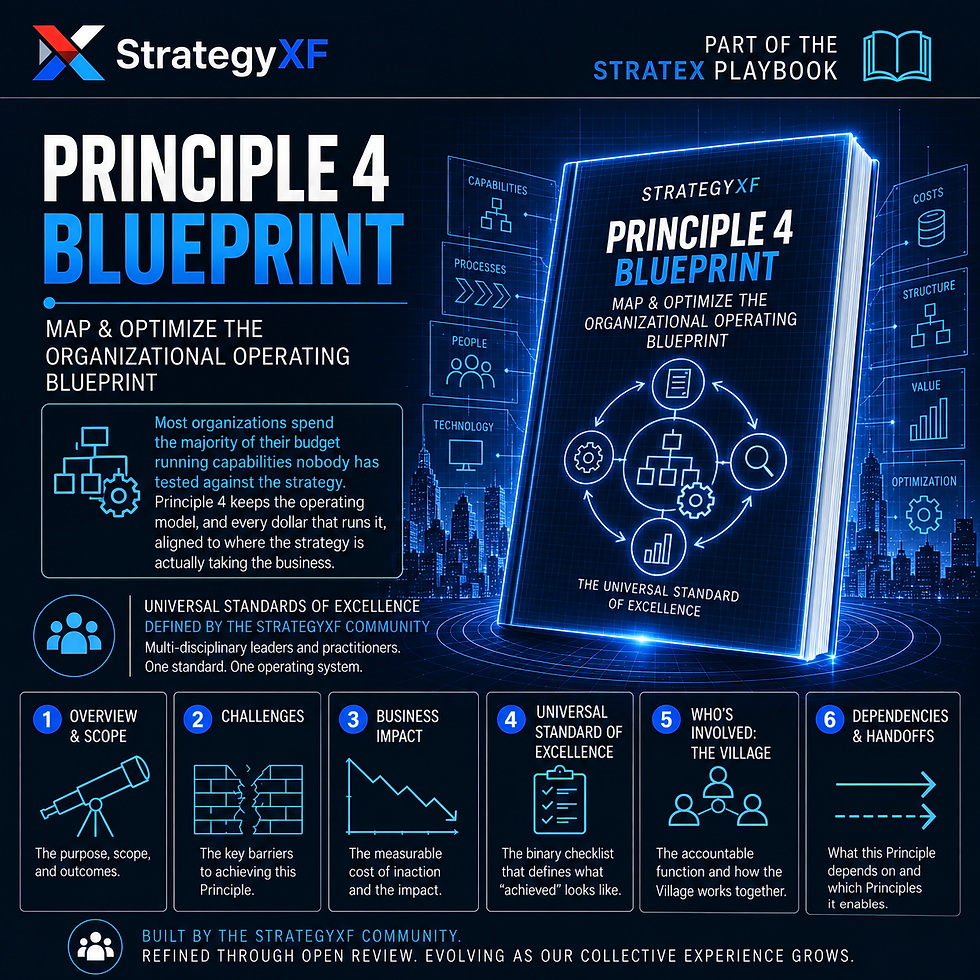
Principle 4 Blueprint: Map & Optimize the Organizational Operating Blueprint - Business & Operating Model Design

Most organizations spend the majority of their budget running capabilities nobody has tested against the strategy. Principle 4 keeps the target operating model, and every dollar that runs it, aligned to where the strategy is actually taking the business.
You can't align what you can't see, or execute on a broken foundation. Most organizations can't say with confidence how they actually operate today. Capabilities are duplicated across functions that don't know about each other. Processes still run on logic inherited from a strategy the organization abandoned years ago. And the large majority of what the organization spends every year keeps flowing to whatever it has always funded, never evaluated against what the strategy now requires.
At StrategyXF, Principle 4 exists to close that gap, replacing a fragmented, self-reinforcing picture of the organization with a single, honest, current one, and using it to close the distance between how the organization actually operates and what executing the strategy requires. This is the official Principle Blueprint for Principle 4, the StrategyXF standard for what building that visibility and discipline requires, and what achieving it looks like.
This Principle Blueprint is StrategyXF's official standard, defined and continuously refined through open review by the multi-disciplinary leaders and practitioners of The Strategy eXecution Forum.
StrateX Playbook: Principle 4 Blueprint: Map & Optimize the Organizational Operating Blueprint - Business & Operating Model Design
Already a member? Read the full BluePrint
Not a member? Apply to become a member
What's inside this BluePrint
Every Principle BluePrint covers six things. Here's what each one found for Principle 3.
Principle Overview & Scope. Principle 4 turns strategic direction back on the organization itself and asks whether it is actually built to deliver it. It replaces a fragmented, self-reinforcing picture of the organization with a single, validated one built across four disciplines, Inform, Understand, Visualize, and Optimize, and uses that picture to close the distance between how the organization actually operates and what its strategy requires, including the large majority of spend that keeps the business running and rarely gets asked whether it still earns its place.
Challenges. Every challenge to achieving Principle 4 traces back to a discipline that is demanding, complex, and slow to show visible returns, so it keeps losing ground to more urgent priorities. Ten distinct barriers stand in the way, from architecture getting reduced to technology, to an operating model that exists only on paper, to operational spend treated as untouchable long after the strategic rationale that once justified it has disappeared.
Business Impact. Without Principle 4, the organization can't see what is consuming the majority of its resources or why its initiatives keep failing. Every initiative pays a tax nobody can see, the operational base runs without strategic scrutiny, locally optimized work can do more harm than good, and competitors who have mapped and optimized their own operating model pull further ahead every cycle this goes unaddressed.
Universal Standard of Excellence Checklist. Fourteen binary outcomes across the four disciplines, Inform, Understand, Visualize, and Optimize, define exactly what "achieved" looks like for Principle 4. No partial credit, no maturity scale to hide behind.
Who's Involved: The Village. Business & Operating Model Design is Accountable, the sole owner of the outcome, because this work touches every function's own capabilities and processes and conflicting priorities are inevitable. It partners with each business unit and shared service to define their target state needs, owns the recommendation when trade-offs arise, and escalates only what crosses functional boundaries and can't be resolved locally.
Dependencies & Handoffs. Principle 4 sits at the center of the Strategy Execution operating system. It depends on the enterprise mandate Principle 2 establishes and the strategic direction Principle 3 translates, and it is foundational to everything Principles 5 through 10 require, from the demand Principle 5 captures to the spend visibility Principle 7 depends on.
What none of this covers is how. The Plays, the specific methods, tools, and approaches organizations use to achieve each Principle, live separately in the StrateX PlayBook. The Blueprint defines what good looks like. The Plays show you how to get there.
"An organization cannot execute effectively while its operating model is misaligned with its strategy, any more than a boat can move at speed while still dragging its anchor. The weight is invisible from the deck. It only shows up as resistance." — From the Principle 4 Blueprint
StrateX Playbook: Principle 4 Blueprint: Map & Optimize the Organizational Operating Blueprint - Business & Operating Model Design
Already a member? Read the full BluePrint
Not a member? Apply to become a member
Why StrategyXF is sharing this
StrategyXF exists to elevate Strategy Execution as a C-Suite imperative, an enterprise discipline every organization must proactively develop. The Principle BluePrints are how we define what "good" looks like across the entire operating system, one Principle at a time, and Principle 4 is where the organization turns that scrutiny on itself.
This Blueprint is a living standard, not a finished one. Have direct experience mapping or optimizing an operating model inside your own organization? The Strategy eXecution Forum reviews every BluePrint section by section before it's finalized, and every Principle will continue to evolve as the community's collective experience grows. Reach out if you'd like to take part in an upcoming review.
About this BluePrint
This Principle Blueprint was defined and reviewed by the multi-disciplinary leaders and practitioners of the Strategy eXecution Forum, senior leaders spanning the C-Suite, Strategy & Operations, Transformation Offices, Finance, HR, IT, PMO, Enterprise Risk, Change Management, Portfolio Management, and Business Architecture. Our thanks to everyone in the Forum who challenged assumptions, pressure-tested the thinking, and helped shape this into StrategyXF's official standard. As the community grows, so will this Blueprint.
Join The Strategy eXecution Forum

The Strategy eXecution Forum (StrategyXF) is an invite-only, no-fee professional community built by and for practitioners who understand the challenges of closing the persistent gap between strategy and results. We believe it requires a collective effort to master strategy execution. StrategyXF brings together senior leaders from across the enterprise: C-suite executives, Strategy & Operations leaders, Transformation Offices, Finance, HR, IT, PMO, Enterprise Risk, Change Management, Portfolio Management, Business Architecture, and more.
Together, we collaborate on real-world challenges, share proven approaches, and shape the future of disciplined and impactful organizational execution. This is not a passive network; it is a practitioner-led community where your experience adds real value. Every discussion is designed to deliver practical ideas you can apply immediately. If you are serious about elevating strategy execution as a mission-critical discipline, we invite you to apply to become a member and help us build something the profession has long needed.