

The Amatya's Mandate: What Chanakya's Saptanga Teaches Us About Closing the Strategy-Execution Gap, by Vidyasagar Uddagiri

Updated: Aug 27
A 4th-century-BCE treatise on statecraft diagnosed the strategy-execution gap — and StrategyXF's 10 Principles are its modern translation.
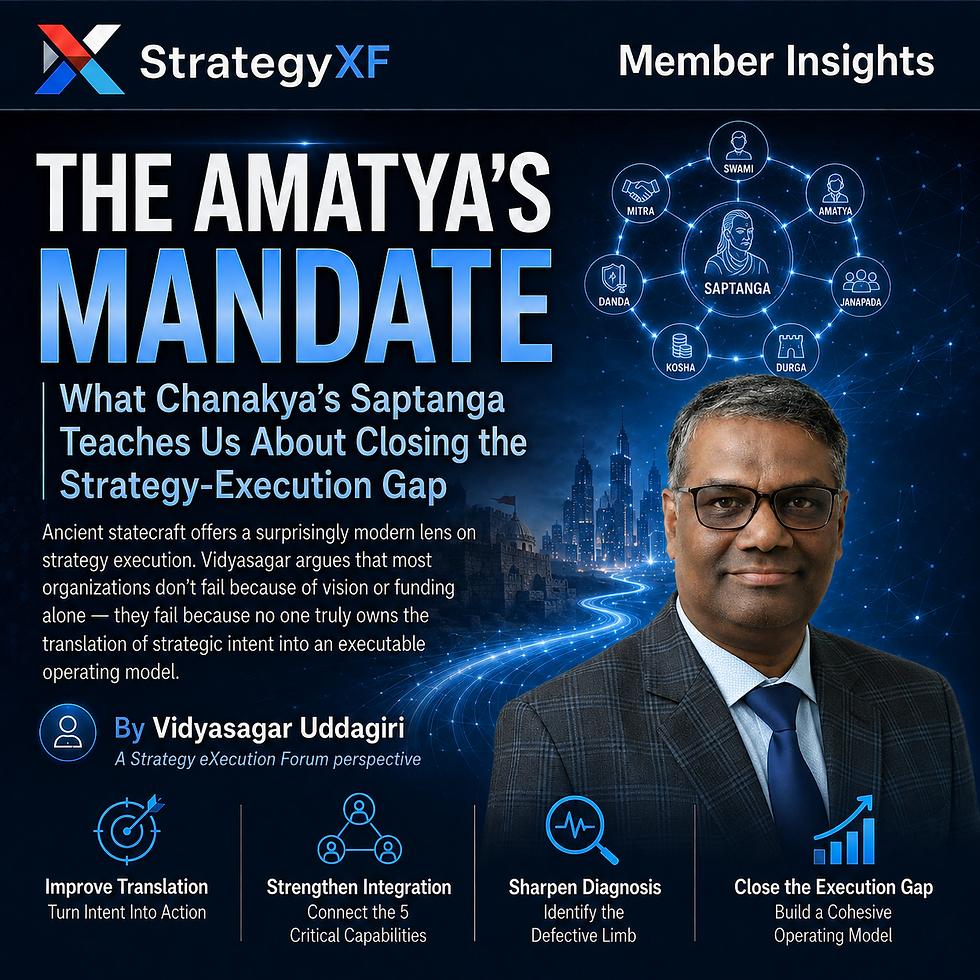
Only 28% of executives and middle managers can name three of their organization's strategic priorities.¹ It's a startling number until you sit inside enough transformation programs to see why — and what's striking, coming at this from an enterprise architecture background, is how old this problem actually is. This Member Insight argues it was diagnosed with real precision over two thousand years ago, and that the diagnosis still holds.
Vidyasagar Uddagiri traces StrategyXF's 10 Key Principles back to a 4th-century-BCE Indian treatise on statecraft — and finds the parallel isn't decorative. It's structural.
This Member Insight comes from Vidyasagar Uddagiri, Consultant CTO & Chief Architect of the BFSI unit at Nagarro, Co-Founder & CTO of SabhyaFN, and a founding member of The Strategy eXecution Forum.
StrategyXF Member Insights: The Amatya's Mandate: What Chanakya's Saptanga Teaches Us About Closing the Strategy-Execution Gap
Already a member? Read the full Guide
Not a member? Apply to become a member
The diagnosis is older than the framework
What's striking, coming at this from an enterprise architecture background, is how old this problem is — and how precisely it was diagnosed in the Arthashastra, often compared to Machiavelli's The Prince though it predates it by roughly 1,800 years. It is, in effect, the world's oldest surviving operating manual for running a complex organization.
Seven limbs, sequenced — not just present
Chanakya's argument wasn't that the seven limbs of the state mattered — everyone knew that. It was that they were interdependent in a specific, sequenced way: a hollow treasury was far harder to recover from than a weak minister. Read against StrategyXF's 10 Key Principles, the parallel isn't decorative. It's structural.
Mapping the limbs to the Principles
The full piece maps all seven limbs — Swami, Amatya, Janapada, Durga, Kosha, Danda, Mitra — onto StrategyXF's 10 Principles, one-for-one. The one that matters most: Amatya, the minister whose job was to take sovereign intent and render it administrable. It's almost a word-for-word description of what Principle 2's Strategy Execution Office is supposed to do — and it's the limb most enterprises get wrong.
"You cannot compensate for a broken Amatya by having a strong Kosha, any more than a well-funded strategy execution office fixes anything if nobody has actually translated intent into an architecture."
What this looks like in practice
Chanakya's framework gives practitioners a diagnostic question sharper than "are we aligned?": which limb, specifically, is defective — and is it recoverable at this stage or not? For most organizations, the honest diagnosis is usually Amatya, not Swami or Kosha. The vision is rarely the problem. The treasury is rarely empty. What's missing is a function with the authority to convert intent into an executable operating model.
StrategyXF Member Insights: The Amatya's Mandate: What Chanakya's Saptanga Teaches Us About Closing the Strategy-Execution Gap
Already a member? Read the full Guide
Not a member? Apply to become a member
Why StrategyXF is sharing this
This piece connects to a broader body of work applying Chanakya's Arthashastra as a governance lens for enterprise architecture — positioning EA as the modern Amatya function. Two thousand years apart, the diagnosis hasn't really changed. Only the vocabulary has.
Have your own hard-won insights on strategy execution? We publish member thinking in the Resource Center and feature the best of it here on www.strategyxf.com. Reach out if you'd like to contribute.
We look forward to hearing where the community sees this pattern showing up in their own organizations.
About the author.

Vidyasagar Uddagiri is a Founding Member of The Strategy eXecution Forum and a portfolio technology executive based in Hyderabad, India, with 30 years of enterprise technology services leadership.
He is currently Consultant CTO and Chief Architect of the BFSI unit at Nagarro, and Co-Founder and CTO of SabhyaFN, a financial planning services startup, alongside work as practitioner faculty and startup mentor. He writes and publishes at the intersection of Enterprise Architecture and Strategy Execution.
Join The Strategy eXecution Forum

The Strategy eXecution Forum (StrategyXF) is an invite-only, no-fee professional community built by and for practitioners who understand the challenges of closing the persistent gap between strategy and results. We believe it requires a collective effort to master strategy execution. StrategyXF brings together senior leaders from across the enterprise: C-suite executives, Strategy & Operations leaders, Transformation Offices, Finance, HR, IT, PMO, Enterprise Risk, Change Management, Portfolio Management, Business Architecture, and more.
Together, we collaborate on real-world challenges, share proven approaches, and shape the future of disciplined and impactful organizational execution. This is not a passive network; it is a practitioner-led community where your experience adds real value. Every discussion is designed to deliver practical ideas you can apply immediately. If you are serious about elevating strategy execution as a mission-critical discipline, we invite you to apply to become a member and help us build something the profession has long needed.
