Technical Debt: A Strategy Execution Risk — by Vidyasagar Uddagiri

Technical debt isn't an engineering problem. It's a board problem.
At StrategyXF, Principle 4 is where we ask organizations to map and optimize the operating blueprint underneath their strategy: the systems, structures and technology that either enable execution or quietly constrain it. Of the five Critical Capabilities inside that blueprint, Business & Enterprise Architecture is the one CXO teams most often still treat as a technology conversation rather than a strategy execution conversation. That gap in framing is exactly where value goes missing, and it's the gap this Play closes.
This Play comes from Vidyasagar Uddagiri, a Founding Member of The Strategy eXecution Forum.
StrategyXF Play: Technical Debt: A Strategy Execution Risk
Already a member? Read the full Play
Not a member? Apply to become a member
The blind spot inside the operating blueprint
Every strategy execution framework rests on one assumption: that the organization has the operating capacity to deliver on what it commits to. That assumption quietly fails the moment a meaningful share of that capacity is already spoken for, consumed by the cost of keeping an aging technology estate running instead of moving strategy forward.
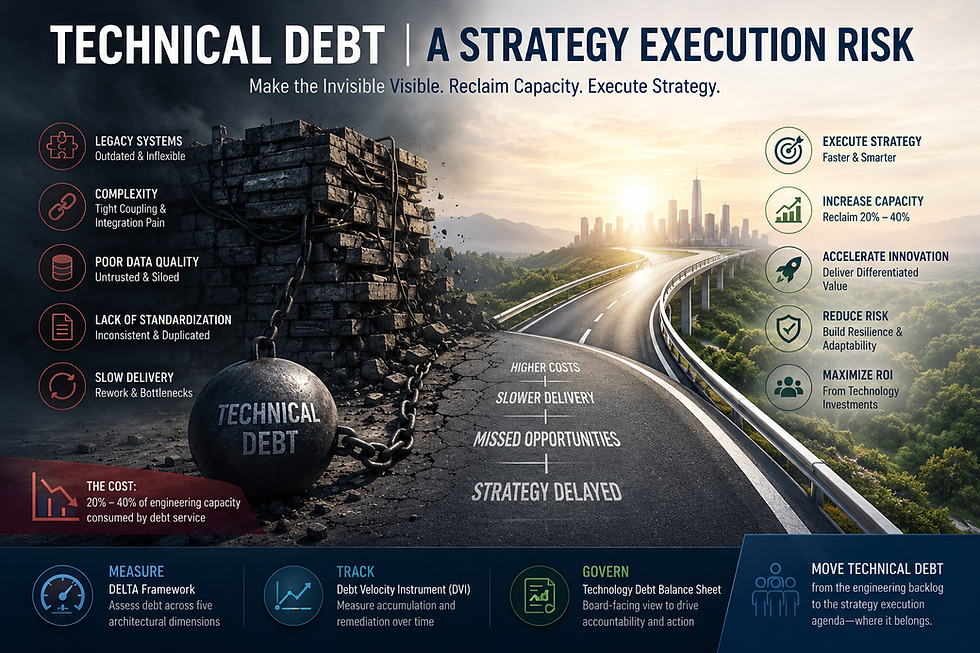
Vidyasagar opens with a familiar failure pattern: a board-approved transformation program that ends up badly over budget and behind schedule, with a post-mortem that blames integration complexity and legacy dependencies without ever naming the real root cause underneath them. The organization was trying to execute a strategy built for today on an architecture built for a decade ago, and the distance between the two was the real cost overrun. That distance has a name. His argument is that it belongs on the strategy execution agenda, not buried in the engineering backlog, and that it's measurable at the scale of billions of workdays of unresolved debt globally and tens of millions of dollars a year for a single mid-sized enterprise.
StrategyXF Play: Technical Debt: A Strategy Execution Risk Already a member? Read the full Play Not a member? Apply to become a member
Three instruments for CXO-level engagement. The Play sets out a practical toolkit for making that gap visible and governable. The DELTA Framework scores an organization's technology estate across five architectural dimensions, producing a single number a board member, a CFO and an architect can all read the same way, tracked quarterly so the trend matters more than any one snapshot. The Debt Velocity Instrument tracks how fast new debt is accumulating against how fast it's being paid down, compressing the estate's trajectory into a single ratio, with a healthy target band rather than a demand for zero new debt. The Technology Debt Balance Sheet is the governance centerpiece: a quarterly, board-facing artifact designed to sit next to the financial balance sheet, so debt management becomes a standing governance expectation rather than an engineering aspiration nobody owns.
Where it hits the five Critical Capabilities. Vidyasagar maps technical debt directly onto all five of StrategyXF's Critical Capabilities, arguing it constrains Strategic Portfolio Management, Business & Enterprise Architecture, Financial Planning & Analysis, Project & Program Execution, and Change Management simultaneously — not as a side effect that happens to touch one of them.
The talent and AI signals. He flags senior engineer attrition as one of the most reliable early warnings of critical debt: the best architects are the first to leave environments where every system is held together by patchwork fixes, and replacing them costs far more than the remediation would have. He raises the same warning for AI: organizations with high debt levels will see AI deployments stall, not because the models are inadequate but because ungoverned data and undocumented systems can't support the reliability and audit trail responsible AI governance demands.
From measurement to governance to investment. The Play closes with a sequenced, four-phase action framework for CXO teams, moving from measuring current-state debt, to standing up governance ownership, to prioritizing remediation investment, with a tangible board-facing output at each phase.
From the Play: an organization doesn't get to choose whether it pays for its technical debt, only whether that payment is deliberate and managed or hidden until it surfaces as a failed strategic initiative.
From the Play: if a CTO can't answer what the organization's current debt cost index is in a board meeting, that's a sign the risk picture is incomplete.
StrategyXF Play: Technical Debt: A Strategy Execution Risk
Already a member? Read the full Play
Already a member? Read the full Guide
Not a member? Apply to become a member
Why StrategyXF is sharing this
StrategyXF exists to elevate Strategy Execution as a C-Suite imperative, and Principle 4 is where that mission runs into the constraint most CXO teams don't yet have language for: the technology estate itself. Vidyasagar's Play gives the community three concrete instruments for turning technical debt from an invisible IT problem into a board-governed strategy execution risk — exactly the kind of community-crowdsourced Play the StrateX Playbook exists to surface.
We look forward to hearing how the community's own organizations are, or aren't, having this conversation at board level.
About the author.

Vidyasagar Uddagiri is a Founding Member of StrategyXF and a portfolio technology executive based in Hyderabad, India, with 30 years of enterprise technology services leadership. He's currently Consultant CTO and Chief Architect of the BFSI unit at Nagarro and Co-Founder and CTO of SabhyaFN, a financial planning services startup, alongside work as practitioner faculty and startup mentor. He writes and publishes at the intersection of Enterprise Architecture and Strategy Execution.
Join The Strategy eXecution Forum

The Strategy eXecution Forum (StrategyXF) is an invite-only, no-fee professional community built by and for practitioners who understand the challenges of closing the persistent gap between strategy and results. We believe it requires a collective effort to master strategy execution. StrategyXF brings together senior leaders from across the enterprise: C-suite executives, Strategy & Operations leaders, Transformation Offices, Finance, HR, IT, PMO, Enterprise Risk, Change Management, Portfolio Management, Business Architecture, and more.
Together, we collaborate on real-world challenges, share proven approaches, and shape the future of disciplined and impactful organizational execution. This is not a passive network; it is a practitioner-led community where your experience adds real value. Every discussion is designed to deliver practical ideas you can apply immediately. If you are serious about elevating strategy execution as a mission-critical discipline, we invite you to apply to become a member and help us build something the profession has long needed.