Why Execution Still Fails in Well Designed Organizations - Guide by Travis Soutter

Complexity isn't the problem. How humans coordinate inside it is.
At StrategyXF, we talk about mastering both the art and the science of Strategy Execution. The science — frameworks, governance structures, planning disciplines — gets most of the attention. The art — the human dimension, the behavioral realities that shape how strategy actually moves through an organization — too often gets treated as secondary. We believe both deserve equal weight. Because in practice, that imbalance is exactly where execution breaks down.
This guide from Travis Soutter, founder of Concordia and researcher in complexity, human coordination and strategy execution, speaks directly to that gap. It is one of the more rigorous treatments of the human side of execution we have encountered, and we are pleased to share it with the StrategyXF community.
Travis is also a founding member of The Strategy eXecution Forum.
StrategyXF Guide: Why Execution Still Fails in Well Designed Organizations
Already a member? Read the full Guide

Not a member? Apply to become a member
The paradox at the center of modern execution
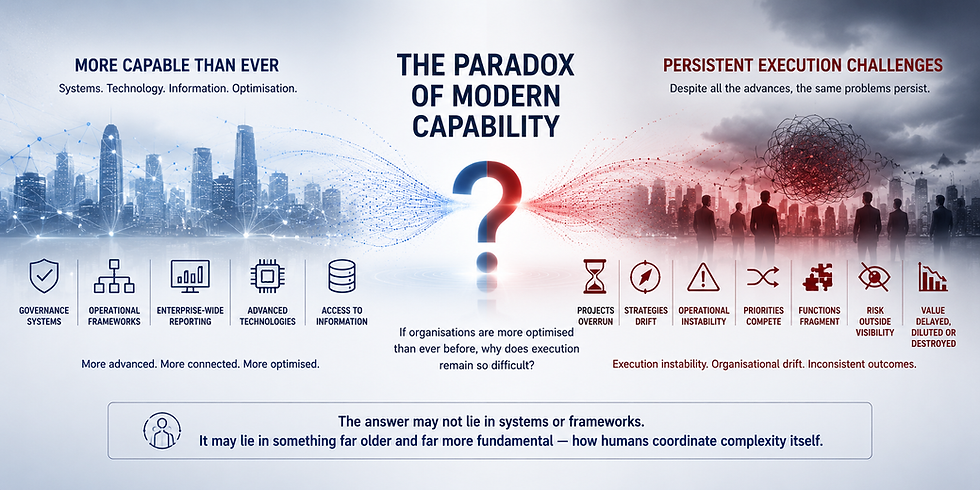
Modern organizations are more capable, more connected and more optimized than at any point in history. Sophisticated governance systems, mature operational frameworks, enterprise-wide reporting, advanced technologies and unprecedented access to information have transformed what organizations can do. And yet execution instability, strategic drift, reactive behavior and inconsistent value delivery persist across virtually every industry.
If organizations are more optimized than ever, why does execution remain so difficult?
Travis Soutter's answer is that the problem may not lie primarily in systems, governance or process maturity. It may lie in something far older and more fundamental: how humans coordinate complexity itself.

The argument Travis makes — and why it matters
The guide builds a layered case across six interconnected dimensions, each supported by original frameworks developed through Concordia's applied research.
Complexity has outpaced our ability to coordinate it. Industrialization, digitalization, globalization and interconnected supply chains have dramatically increased organizational complexity — and with it, coordination pressure. Technology improves capability, but it also increases interdependence. As systems become more connected, information loads increase, decision speed accelerates and consequences become harder to predict. The result is a coordination overhead that, when poorly managed, quietly inflates operating cost while suppressing value delivery.
Frameworks alone cannot close the gap. Modern management frameworks have delivered extraordinary organizational value. But execution still occurs through human interpretation, local priorities, emotional pressure, incentives and competing trade-offs. Two functions can operate inside the same governance system while interpreting priorities, risks, urgency, accountability and value very differently. Structure does not guarantee coordinated interpretation.
The strategy signal weakens as it travels. Travis introduces the S.I.D.E. Model — Signal, Interpretation, Decision, Execution — to illustrate how strategic intent distorts as it moves through an organization. The same direction that appears clear at the top is filtered through individual understanding, functional lens and local assumptions at every layer below it, producing different decisions and ultimately different outcomes. The gap between intent and results rarely forms because strategy is absent. It forms during interpretation.
Humans simplify complexity in order to function inside it. Drawing on Kahneman, Dorner and complexity science, Travis argues that human simplification is not a weakness — it is an adaptive necessity. No individual can fully process all variables, all interdependencies and all competing priorities simultaneously. The danger is not that simplification occurs. It is what gets selected out: the uncomfortable risks, the low-visibility dependencies, the long-term trade-offs. These do not disappear. They accumulate silently — individually tolerable, collectively destabilizing — until instability forces its way back into the system through firefighting, escalation and reactive prioritization.
Poorly coordinated complexity carries a measurable economic cost. Research suggests organizational complexity can add 20% or more to operating cost structures. When complexity becomes poorly coordinated, hidden value erosion accumulates through margin erosion, rework, delays, duplication and capital inefficiency — while operational instability builds through reactive load, execution drift, dependency friction and fragmented priorities. These symptoms are typically treated as isolated operational issues rather than what they are: interconnected coordination failures emerging from the broader system.
Coordination may be the defining organizational capability. The organizations that better understand how interpretation, incentives, emotion, structure and governance shape execution may ultimately be the ones that deliver value more consistently over time — not because they eliminate complexity, but because they become better at coordinating it.
StrategyXF Guide: Why Execution Still Fails in Well Designed Organizations
Already a member? Read the full Guide
Not a member? Apply to become a member
Why StrategyXF is sharing this
StrategyXF exists to elevate Strategy Execution as a C-Suite imperative. That mission requires confronting the full picture — the systems and the humans operating inside them, the science and the art, the frameworks and the behavioural realities that determine whether those frameworks ever land.
Travis's work is a rigorous and timely contribution to the human side of that equation. The models he introduces — the S.I.D.E. Model, the Human Simplification Cycle, the Inverse Awareness Relationship, the Concordia Strategy Distortion Model — offer practitioners a genuinely useful lens for diagnosing where coordination is breaking down and why.
We look forward to engaging the StrategyXF community in the perspectives this article raises.
Join The Strategy eXecution Forum

The Strategy eXecution Forum (StrategyXF) is an invite-only, no-fee professional community built by and for practitioners who understand the challenges of closing the persistent gap between strategy and results. We believe it requires a collective effort to master strategy execution. StrategyXF brings together senior leaders from across the enterprise: C-suite executives, Strategy & Operations leaders, Transformation Offices, Finance, HR, IT, PMO, Enterprise Risk, Change Management, Portfolio Management, Business Architecture, and more.
Together, we collaborate on real-world challenges, share proven approaches, and shape the future of disciplined and impactful organizational execution. This is not a passive network; it is a practitioner-led community where your experience adds real value. Every discussion is designed to deliver practical ideas you can apply immediately. If you are serious about elevating strategy execution as a mission-critical discipline, we invite you to apply to become a member and help us build something the profession has long needed.