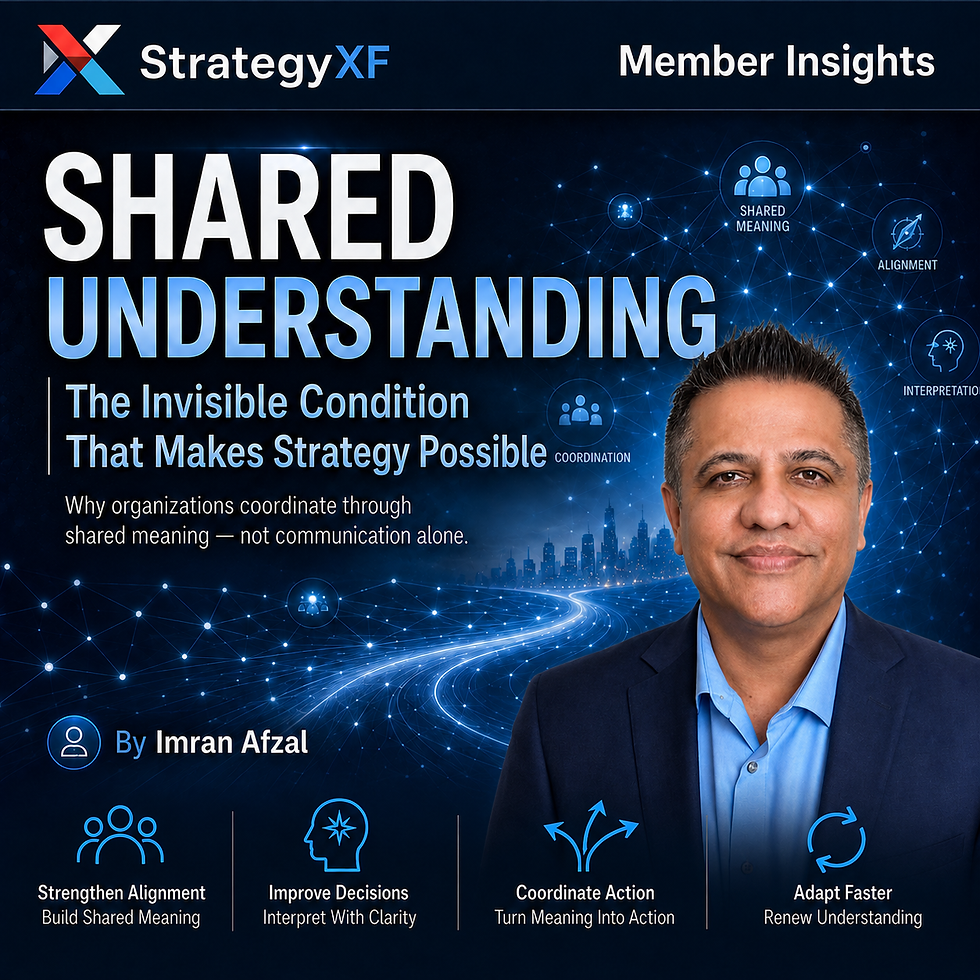
Shared Understanding: The Invisible Condition That Makes Strategy Possible, by Imran Afzal

Updated: Aug 13
Alignment isn't a communication problem. It's a living system problem.
Most strategy failures don't announce themselves as failures. At StrategyXF, Principle 3 is where we ask organizations to translate and communicate strategic direction so that it actually lands the same way for everyone who has to act on it. This Member Insight goes underneath that Principle, into the layer most organizations never examine directly: the ongoing, invisible work of turning information into shared meaning, and shared meaning into coordinated action. When that work quietly breaks down, the Principle fails even when every visible process around it looks fine.
This Member Insight comes from Imran Afzal, a founding member of The Strategy eXecution Forum and author of the Seeing Organizations philosophy.
StrategyXF Member Insights: Shared Understanding: The Invisible Condition That Makes Strategy Possible
Already a member? Read the full Guide
Not a member? Apply to become a member
The pattern hiding in plain sight
Imran opens with a familiar sequence: a conversation that everyone thought was resolved, resurfacing weeks later in a different meeting. A dashboard built for clarity that becomes the center of debate instead. An escalation nobody expected. Taken individually, each has a reasonable explanation and a local fix. Taken together, they suggest something else is going on beneath the surface, something interpretive rather than operational, that no org chart or governance structure can capture on its own.
Organizations as living systems, not org charts
The Insight's central move is a reframe. Strategy, governance, culture, technology and process are the visible components of an organization, but none of them individually explains why organizations behave the way they do. What actually drives behavior is the network of relationships beneath them, the ongoing process by which people assign meaning to information and build shared understanding together. When that process is healthy, well-designed structures work. When it drifts, even the best structures gradually stop working, and the drift is very hard to see from inside it because confidence tends to stay high right up until it doesn't.
StrategyXF Member Insights: Shared Understanding: The Invisible Condition That Makes Strategy Possible - Already a member? Read the full Guide Not a member? Apply to become a member
Why this cuts across all 10 Principles, not just one
Imran's argument isn't confined to communication mechanics. He positions shared understanding as the invisible condition underneath execution generally, meaning it shows up wherever a Principle depends on people acting on a common interpretation of intent, not just Principle 3. A portfolio decision, a governance escalation, a change program stalling out: each can trace back to the same root cause if you look for it.
From the Insight:"The future will belong less to organizations with the most information than to organizations that most effectively transform information into shared understanding."
Where to start looking
Rather than prescribing a framework, the Insight closes with a set of recognizable patterns worth watching for: recurring conversations, decisions that need repeated clarification, teams that confidently interpret the same strategy two different ways. None of these are evidence of failure on their own. What matters is whether they show up as isolated exceptions or start forming a pattern over time, because that's the earlier and more honest signal that shared understanding is diverging faster than it's being renewed.
StrategyXF Member Insights: Shared Understanding: The Invisible Condition That Makes Strategy Possible
Already a member? Read the full Guide
Not a member? Apply to become a member
Why StrategyXF is sharing this
StrategyXF exists to elevate Strategy Execution as a C-Suite imperative, and Principle 3 is where that mission runs into a gap most organizations don't have language for yet: the ongoing, invisible work of keeping meaning aligned across the enterprise. Imran's Member Insight gives the community a new lens for that gap, one that treats organizations as living systems rather than static structures, exactly the kind of community-crowdsourced thinking the Resource Center exists to surface.
Have your own hard-won insights on strategy execution? We publish member thinking in the Resource Center and feature the best of it here on www.strategyxf.com. Reach out if you'd like to contribute.
We look forward to hearing where the community sees this pattern showing up in their own organizations.
About the author.

Imran Afzal is a founding member of The Strategy eXecution Forum and the creator of Seeing Organizations, a philosophy for understanding organizations by revealing the invisible relationships that shape visible behavior.
Drawing on a background in biology, he writes essays and a LinkedIn newsletter, The Strategic PMO.
Join The Strategy eXecution Forum

The Strategy eXecution Forum (StrategyXF) is an invite-only, no-fee professional community built by and for practitioners who understand the challenges of closing the persistent gap between strategy and results. We believe it requires a collective effort to master strategy execution. StrategyXF brings together senior leaders from across the enterprise: C-suite executives, Strategy & Operations leaders, Transformation Offices, Finance, HR, IT, PMO, Enterprise Risk, Change Management, Portfolio Management, Business Architecture, and more.
Together, we collaborate on real-world challenges, share proven approaches, and shape the future of disciplined and impactful organizational execution. This is not a passive network; it is a practitioner-led community where your experience adds real value. Every discussion is designed to deliver practical ideas you can apply immediately. If you are serious about elevating strategy execution as a mission-critical discipline, we invite you to apply to become a member and help us build something the profession has long needed.