Expose the Cost of Poor Strategy Execution: Principle 1 of the 10 Key Principles to Master Strategy Execution

Updated: May 13
The statistics on strategy execution failure are alarming. Seventy percent of strategic investments fail to deliver expected outcomes. Additionally, sixty-seven percent of well-formulated strategies fail during execution. C-suite leaders acknowledge these figures, yet the conversation often shifts quickly to other topics.
What these statistics fail to convey is the actual cost of poor strategy execution to your organization. This is the gap that Principle 1 seeks to address. It is not merely the first of ten principles; it is the foundation for all subsequent principles.
Already a member? Read the full Guide

Not a member? Apply to become a member
The Question That Actually Drives Action
Data on execution failure has been available for years. What I find striking is not that organizations struggle, but that C-suite executives continue to view it as a cost of doing business rather than a strategic crisis. This perspective is straightforward: no one has connected execution shortfalls to tangible financial impacts that the boardroom can act upon.
Most C-suite leaders consider strategy execution through the lens of program management, focusing on the delivery of major transformation programs and strategic initiatives. At this level, some failure seems expected. A five to ten percent loss is often written off as a cost of doing business—frustrating, yet manageable.
This framing is understandable but dangerously incomplete.
"Nobody has walked into the boardroom and said—clearly, with evidence—'here is exactly what our inability to execute strategy is costing us, in our portfolio, in our operations, in deferred and destroyed value.' Until that number exists, the urgency to act doesn't either."

The Waste That Stays Invisible
Research from StrategyXF identifies where value is lost and deferred, organized into two categories of risk.
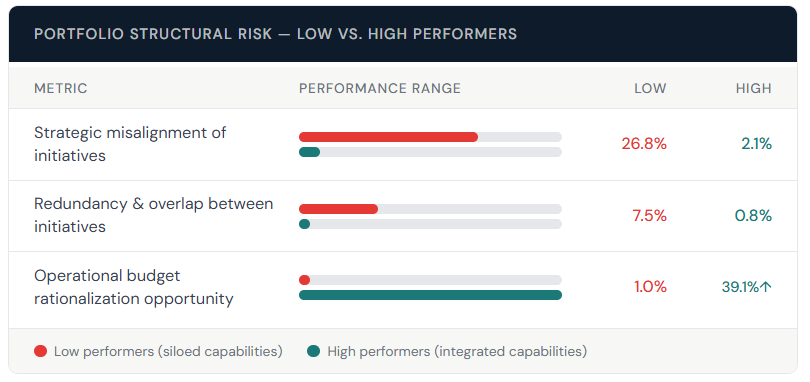
Portfolio Structural Risk
This category encompasses the opportunity cost incurred before execution even begins. It arises from poor portfolio planning, weak architectural discipline, and operational spending that is never rationalized against strategic priorities. Low-performing organizations lose over thirty-four percent of portfolio value before a single project enters delivery.
Portfolio Execution Risk
This category reflects the tangible financial impact of poor delivery performance, including project failures, cost overruns, and schedule delays. Low performers face a thirty-one percent permanent value loss and a thirty-five percent value deferral from execution risk alone.
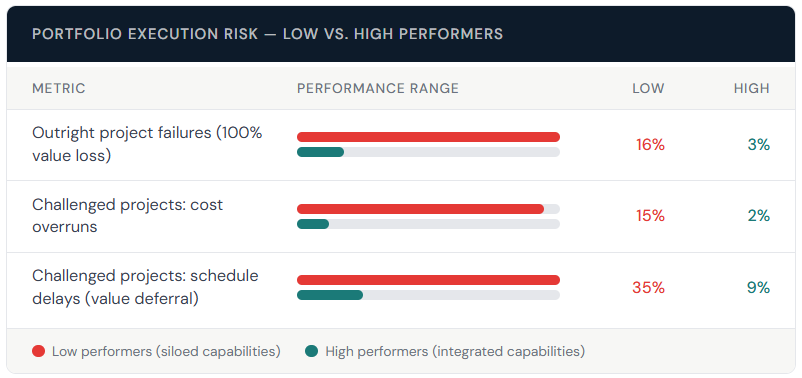
The difference between low and high performers is significant. High performers who have systematically invested in integrating their strategy execution capabilities achieve two to ten times better results across every critical value dimension. For a typical large organization, this translates to hundreds of millions of dollars annually.
What Principle 1: Expose the Costs of Poor Strategy Execution Actually Requires
Achieving Principle 1 involves four interconnected activities. All four must be completed before Principle 2 can begin with the authority it requires.
1. Define Strategy Execution
Establish a shared understanding among C-suite executives of what strategy execution entails, what it covers, and why it extends far beyond program management.
2. Build the Value Case
Personalize the StrategyXF research to reflect the organization's own portfolio and operational realities, making the cost of inaction impossible to dismiss.
3. Establish a Strategy Execution Office
Make the case for a dedicated enterprise function staffed internally. This office should have the mandate to assess capability and design a personalized operating model.
4. Secure C-Suite Commitment
This commitment should not come from just one enthusiastic executive. It requires collective leadership commitment, with a named accountable C-suite member and the SEO reporting directly to them.
The consequence of leaving Principle 1: Expose the Cost of Poor Strategy Execution unachieved is not merely that the business case goes unmade. Everything downstream fails to gain the traction it needs. The fractured operating model that quietly destroys value each year remains unchanged because no one with the authority to alter it has been given a compelling reason to act.
Already a member? Read the full Guide
Not a member? Apply to become a member

The Strategy eXecution Forum (StrategyXF) is an invite-only, no-fee professional community built by and for practitioners who understand the challenges of closing the persistent gap between strategy and results. We believe it requires a collective effort to master strategy execution. StrategyXF brings together senior leaders from across the enterprise: C-suite executives, Strategy & Operations leaders, Transformation Offices, Finance, HR, IT, PMO, Enterprise Risk, Change Management, Portfolio Management, Business Architecture, and more.
Together, we collaborate on real-world challenges, share proven approaches, and shape the future of disciplined and impactful organizational execution. This is not a passive network; it is a practitioner-led community where your experience adds real value. Every discussion is designed to deliver practical ideas you can apply immediately. If you are serious about elevating strategy execution as a mission-critical discipline, we invite you to apply to become a member and help us build something the profession has long needed.