The 10 Principles Every Organization Must Master to Execute Strategy — Rejecting a One-Size-Fits-All Framework

Updated: Sep 5
Most organizations don't have a strategy problem. They have an execution problem.
Research shows that 90% of corporate strategies are never fully implemented. Not because the strategies are bad. Because something breaks between the boardroom and the front line, every single time.
And yet, most organizations respond to execution failure the same way: by adopting another methodology. A new framework. A better tool. A rebranded PMO. The cycle repeats, and the strategy-to-execution gap stays stubbornly wide.
At the Strategy eXecution Forum (StrategyXF), we believe there are two root causes driving most of this failure, and a fundamentally different way to think about solving it.
The 10 Key Principles are StrategyXF's official standard, defined and continuously refined through open review by the multi-disciplinary leaders and practitioners of The Strategy eXecution Forum.
Read the Full Guide: Read the Full Guide: The 10 Principles to Master Strategy Execution
Already a member? Read the Full Guide

Not a member? Apply to become a member
Root Cause #1
The functions that need to work together don't
Strategy execution isn't a one-team job. It requires PMOs, finance, HR, enterprise architects, change managers, product leaders, and the C-Suite to operate as a coordinated system. But in most organizations, those functions optimize independently, each with its own processes, tools, and priorities. Nobody owns the seams. Value leaks through the gaps.
Root Cause #2
One-size-fits-all methodologies don't fit anyone well
Every decade brings a new methodology promising to finally crack the code: Balanced Scorecard, Agile at Scale, OKRs, SAFe. Each has merit. Each also gets force-fitted onto organizations with completely different cultures, industries, and operating contexts. The framework gets implemented. People comply. And a few years later, we're back to square one.
The fix isn't a better framework. It's building a personalized operating model that unites your critical functions, and measuring it against universal standards of excellence that every organization must achieve to master strategy execution.Here's an uncomfortable truth: most organizations don't have a strategy problem. They have an execution problem.
What's inside this Guide
Every Principle Blueprint covers six things for one Principle. The full Guide covers the same six things across all 10.
All 10 Principles, defined. Clear, methodology-agnostic definitions for each of the 10 Key Principles, with no prescribed "how."
Why each one matters. The business impact of leaving that Principle unaddressed, in plain terms the C-Suite already recognizes.
Universal Standards of Excellence. The binary checklist that defines what "achieved" looks like for each Principle. No partial credit, no maturity scale to hide behind.
The Village. Who across the organization owns, contributes to, and is accountable for each Principle, from the C-Suite down to the practitioners doing the work.
How the Principles connect. The dependencies and handoffs that link all 10 into a single operating system, rather than 10 disconnected initiatives.
Where the Plays live. The Guide defines what good looks like. The specific methods, tools, and approaches for getting there live separately in the StrateX Playbook, built by the community.

Introducing the 10 Key Principles of Strategy Execution
We've defined 10 Key Principles, universal standards of excellence that every organization must achieve, regardless of industry, size, or methodology. These principles connect the full cross-functional village, C-Suite leaders, Strategy Execution Offices, PMOs, enterprise architects, finance, HR, change managers, and more, across five critical capabilities: Strategic Portfolio Management, Business and Enterprise Architecture, Financial Planning and Analysis, Project Execution, and Change Management.
What's not prescribed is how you achieve each principle. That's where the StrateX Playbook comes in, a community-driven collection of battle-tested plays contributed by practitioners across industries, so organizations can choose the approaches that actually fit their context.
Here's a quick overview of all 10 Principles to master Strategy Execution:
Expose the Cost of Poor Strategy Execution: Value is lost and deferred every day. Build the case that makes C-Suite commitment a no-brainer.
Establish the Strategy Execution Operating Model: Minimum enterprise standards. Lean governance. One unified foundation for execution.
Translate & Communicate Strategic Direction: Formulate clearly. Decompose rigorously. Communicate bidirectionally. Give every team a north star.
Map & Optimize the Organizational Operating Blueprint: You can't align what you can't see, or execute on a broken foundation.
Capture & Qualify All Demand: Capture the right information consistently, so every initiative can be confidently evaluated.
Continuously Optimize the Strategic Roadmap: A roadmap is never finished. Optimize, rebalance, and activate it continuously.
Make Financial Data Integral to Strategy Execution: Make financial data live at the heart of strategy execution, not arrive after the fact.
Build the Workforce & Culture for Strategy Execution: Right skills. Right incentives. Every employee committed and motivated to deliver.
Empower Execution & Drive Change: Embrace autonomy within the guardrails. Track every initiative. Drive change across the organization.
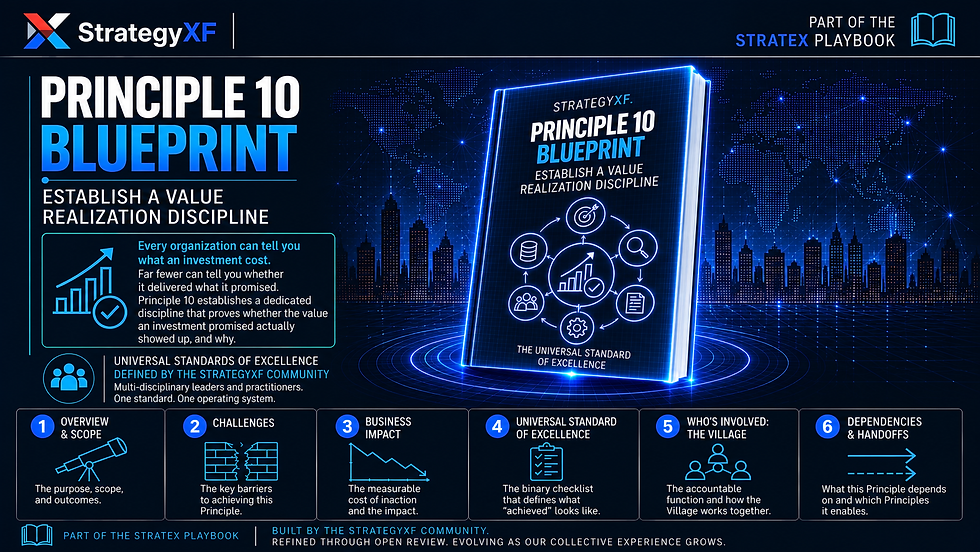
Establish a Value Realization Discipline: Measure what was promised. Build the systems. Hold people accountable.
Together, these principles address both the science of execution (the processes, governance, and systems) and the art (the human factors that determine whether any of it actually sticks).
The 10 Principles aren't something to adopt wholesale. They're a way to honestly assess where your organization is strong, and where value is quietly leaking away.
Read the Full Guide: Read the Full Guide: The 10 Principles to Master Strategy ExecutionPrinciple
Already a member? Read the Full Guide
Not a member? Apply to become a member
This isn't a framework. It's a mirror.
The plays you use to achieve each principle will vary. The principles themselves won't.
We're building the StrategyXF community to co-create the StrateX Playbook, crowdsourcing the approaches that practitioners across functions and industries are actually using. If you're a PMO leader, transformation director, enterprise architect, CFO, or change manager, your experience belongs in this playbook.
Why StrategyXF is sharing this
StrategyXF exists to elevate Strategy Execution as a C-Suite imperative, an enterprise discipline every organization must proactively develop. The 10 Key Principles are where that mission becomes practical, giving every organization a shared, methodology-agnostic language for closing the strategy-to-execution gap.
This Guide is a living standard, not a finished one. Have direct experience achieving one of these Principles inside your own organization? The Strategy eXecution Forum reviews every Principle section by section before it's finalized, and the Guide will continue to evolve as the community grows.
About this Guide
This Guide was defined and reviewed by the multi-disciplinary leaders and practitioners of the Strategy eXecution Forum, senior leaders spanning the C-Suite, Strategy & Operations, Transformation Offices, Finance, HR, IT, PMO, Enterprise Risk, Change Management, and Portfolio Management.
Our thanks to everyone in the Forum who challenged assumptions, pressure-tested the thinking, and helped shape this into StrategyXF's official standard. As the community grows, so will this Guide.
Join The Strategy eXecution Forum

The Strategy eXecution Forum (StrategyXF) is an invite-only, no-fee professional community built by and for practitioners who understand the challenges of closing the persistent gap between strategy and results. We believe it requires a collective effort to master strategy execution. StrategyXF brings together senior leaders from across the enterprise: C-suite executives, Strategy & Operations leaders, Transformation Offices, Finance, HR, IT, PMO, Enterprise Risk, Change Management, Portfolio Management, Business Architecture, and more.
Together, we collaborate on real-world challenges, share proven approaches, and shape the future of disciplined and impactful organizational execution. This is not a passive network; it is a practitioner-led community where your experience adds real value. Every discussion is designed to deliver practical ideas you can apply immediately.
If you are serious about elevating strategy execution as a mission-critical discipline, we invite you to apply to become a member and help us build something the profession has long needed.