Why I founded the Strategy eXecution Forum & why it matters more than ever!

Updated: Mar 12

Thirty Years in the Trenches (Not That I'm Counting)
I've been working in some aspect of Strategy Execution for longer than I care to remember — somewhere north of thirty years. And over that time, one thing has become crystal clear: Strategy Execution is not a single discipline owned by any one team or function. It's a huge, sprawling space — the convergence of different roles, functions, and processes that all need to come together for an organization to actually deliver on its strategy. No single person, function, or consulting firm has all the answers. I certainly don't.
My own corner of this world has always been Project, Program, and Portfolio Management. I started out as a project manager and Quantity Surveyor in the UK, where I got my hands dirty managing complex programs. From there I moved into management consulting, helping organizations build governance processes and stand up PMOs. Then in 2002 I joined a company called UMT — and that's where things got really interesting.
Building Something That Actually Mattered
UMT had a strong opinion: Portfolio Management should be a lot more than pretty dashboards and status reports. So we got to work building methodologies, frameworks, and software to help organizations objectively align their initiatives with strategic priorities — real what-if analysis, genuine prioritization, and optimization tools to help leaders pick the right investments. We also spent time with Gartner to shape the conversation, and together we helped influence the creation of the Project & Portfolio Management (PPM) research area, established by Matt Light in 2004.
Our portfolio management product was acquired by Microsoft, and I joined the team there to integrate our capability and framework into the Microsoft Project platform. If you use Microsoft's PPM platform today, some of that work is still in there.
We eventually left Microsoft to found UMT360 and finish what we'd started. UMT360 SPM ended up as a top-four solution in Gartner's Strategic Portfolio Management Magic Quadrant — something I'm genuinely proud of. We also worked closely with Gartner analyst Dan Stang to push for bifurcating PPM into two separate disciplines: Strategic Portfolio Management (SPM) and Adaptive Project Management & Reporting. The goal was to force the conversation — because SPM kept getting pushed aside in favor of task-level execution work, and we felt that needed to change.
We later sold UMT360, and I spent a couple of years integrating the product, the team, and our frameworks into the acquiring organization.
I'm sharing all of this not to blow my own trumpet — honestly, it probably amounts to a small ripple in a very big pond. But I want to be upfront about where I'm coming from. My lens on Strategy Execution is firmly rooted in the project, program, and portfolio management world. It's not the whole picture. Not even close.

The Question I Couldn't Shake
When that chapter ended, I hit the classic fork in the road: start a boutique consulting firm or build the next great software product (you know, the one that solves everything and disrupts the market inside eighteen months). Before I committed to either, I decided to take a proper look at what was actually going on out there.
I spent a lot of time on LinkedIn. I had conversations with former clients and peers. I reflected on years' worth of customer interactions. And what I kept hearing — and seeing — was deeply frustrating: despite all the investment in process improvement and shiny new tools, most organizations are still struggling to close the gap between strategy and execution.
After spending my entire career trying to help fix this, that hit hard. I wanted to figure out why — and the more I dug in, the more three root causes kept coming up:
The C-Suite Doesn't Really Get What's at Stake: Here's what genuinely puzzles me: most executives don't fully grasp the impact of weak strategy execution capabilities — or how much business value is quietly bleeding away as a result. Are they unaware of the scale of the problem? Or have they quietly filed it under "cost of doing business" and moved on?
Look, program execution isn't a perfect science. Some waste is expected — that's just reality. If you're losing five to ten percent of your expected value? Frustrating, but manageable. But from everything I've seen and researched, the actual business value at risk from poor strategy execution is far higher than that. And it's not being treated with anything close to the urgency it deserves.
It Takes a Village — But Nobody's Running the Village: As I said upfront: Strategy Execution belongs to everyone and no one at the same time. Enterprise Risk, Strategy, EPMOs, Transformation Offices, Business Architecture, Operations, Finance, HR, IT, Portfolio Leaders, Departmental PMOs, Product and Program Managers, Change Managers, Business Analysts, Enterprise Architects — they all own a piece of it.
And that's actually fine. The problem is what happens when you zoom out. Each function optimizes its own slice in isolation, doing perfectly reasonable work in its own lane. But when you bring it all together, you end up with a fractured operating model — and business value doesn't get delivered so much as it seeps through the cracks between teams.
One-Size-Fits-All Actually Fits Nobody: We keep doing this thing where we reach for the next big framework — the one that's going to fix everything the last one got wrong — and somehow end up repeating the same mistakes with new branding.
Take PPM. When Gartner brought project and portfolio management together in 2004, PMO teams inherited this capability and — reasonably enough — started at the bottom: get task management right, make sure the timesheets are accurate, get projects tracked properly. Portfolio management, which is where the real strategic value sits, kept getting pushed to later. It never quite arrived.
Then around 2014, the story shifted again. PPM was the problem — too waterfall-heavy, too rigid. Agile was the answer. I'm not anti-Agile, genuinely. But we didn't learn from what happened before. Teams got a fresh, energizing new way to deliver work from the bottom up, and portfolio management got deferred again. Sound familiar?
Every function has gone through some version of this cycle. And the honest conclusion? One-size-fits-all fits no one. If you want to actually master strategy execution, you have to build something tailored — an operating model that reflects your organization's specific culture, industry, geography, and personality.
So Why a Community?
After working through all of this, starting another consulting firm felt pointless. The market doesn't need another one. Building another software product felt equally off — the problem isn't that we're short on tools or methodologies. The problem is a lack of shared understanding, genuine cross-functional collaboration, and real C-Suite commitment.
What I kept coming back to was this: what's actually missing is a place where practitioners from every corner of Strategy Execution can get together — no vendor agenda, no single-function bias — and have honest conversations about what's working and what isn't.
Somewhere they could share real experiences, call out what's broken, and help each other figure out what good actually looks like.
That's why I founded the Strategy eXecution Forum — StrategyXF.

What The Strategy eXecution Forum Is — and What We're Trying to Do
At its heart, StrategyXF is a community of practitioners and leaders who are frustrated with the status quo and want to change it. We're talking about people from Strategy & Operations, Finance, Enterprise Risk, Business Architecture, Portfolio Management, HR, IT, PMOs, Enterprise Architecture, Change Management, and everywhere in between — the full cross-functional village that strategy execution actually requires.
Our shared mission is to elevate Strategy Execution as a mission-critical discipline — one that every C-Suite treats as a genuine organizational imperative, not an afterthought or a cost of doing business. We want to get to a place where executives don't just tolerate strategy execution capability gaps — they proactively invest in closing them.
And critically, we want this to be an engaging, energizing place to be. Not another dry industry forum with recycled slide decks. A real community where smart, experienced people enjoy showing up, sharing what they know, challenging each other's thinking, and walking away with things they can actually use.
The First Right Step: A Strategy Execution Office
One of the core things we want to help practitioners do is make the case for a new kind of enterprise function — what we call a Strategy Execution Office (SEO). The name matters less than the mindset behind it.
The idea is straightforward: if strategy execution is truly a cross-functional challenge, then you need a cross-functional solution. That means establishing a dedicated function — with genuine C-Suite backing — whose job is to build a personalized, cohesive operating model that unites all the critical teams and processes responsible for different parts of strategy execution.
Not a new layer of bureaucracy. Not another framework imposed from the top. A unifying function that brings the village together, aligns how everyone works, and — ultimately — plugs the value leakage that's costing organizations so much. When it works, you don't just stop losing value. You start accelerating and maximizing it.
Getting there requires C-Suite commitment. That's why a big part of what StrategyXF does is help members build the business case and secure the executive sponsorship to make this happen in their own organizations.
The StrateX Playbook: Crowd-Sourcing What Actually Works
Here's something we feel strongly about: we are done with one-size-fits-all frameworks. They fit nobody — and frankly, the strategy execution community deserves better.
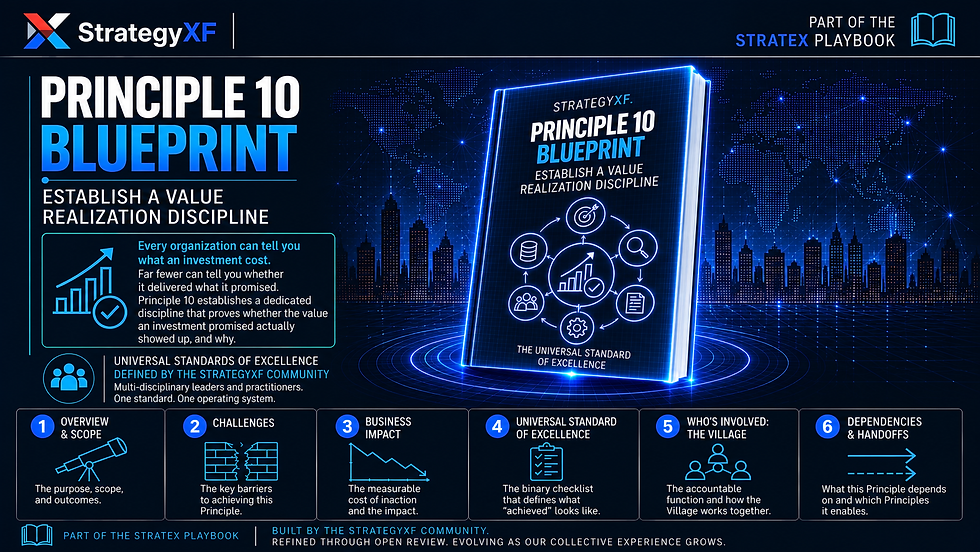
Instead, we've organized everything around the 10 Key Principles of Strategy Execution. These are the things every organization needs to master to close the strategy-execution gap — the non-negotiables. But here's where we do things differently: we don't prescribe one way to achieve them. We recognize that different organizations, cultures, industries, and geographies will get there in different ways.
So rather than hand everyone the same playbook, we're crowd-sourcing it. Members share the plays, best practices, and approaches that have actually worked for them — organized around each of the 10 Principles. Over time, we're building a living StrateX Playbook: a community-validated collection of real approaches that practitioners can draw from, adapt, and personalize for their own context.
It's not theory. It's not consulting IP. It's what's actually working, shared openly by the people doing the work.

Our Six Community Objectives
To make all of this real, StrategyXF is organized around six core objectives. They're not aspirational fluff — they're the specific things we're committed to delivering for our members.
Inclusive Community Building: Strategy execution belongs to everyone — so our community has to reflect that. We bring together practitioners and leaders from every critical function: C-Suite executives, Enterprise Risk, Transformation Offices, Strategy, Operations, Business Architecture, Finance, HR, IT, Portfolio Leaders, PMOs, Product and Program Managers, Change Managers, Enterprise Architects, Project Managers, Scrum Masters, Business Analysts, and more. Every perspective matters. The more complete our picture, the better our collective output.
Peer-to-Peer Knowledge Sharing: This is the beating heart of StrategyXF. We want to cultivate a genuinely active, inclusive, and — let's be honest — enjoyable community where people collaborate openly, share real-world experiences and battle-tested insights, and challenge each other's thinking. The best breakthroughs in strategy execution don't come from keynote stages or vendor whitepapers. They come from honest, high-trust conversations between people actually doing the work.
Celebrating Member Excellence: Communities thrive when the people who show up and contribute generously get recognized for it. We actively celebrate the contributors, advocates, thought leaders, and practitioners who share their expertise, drive meaningful discussions, and make StrategyXF a better place for everyone. If you put in, you get seen.
Securing Executive Sponsorship: One of the most important things we do together is help members make the case upward. We co-develop the positioning, messaging, and business cases that help practitioners get the C-Suite attention and commitment this discipline deserves. The goal isn't just a good conversation in the boardroom — it's the establishment of a dedicated enterprise function, like a Strategy Execution Office or Transformation Management Office, that has the mandate and backing to actually build a cohesive operating model and drive change.
Community-Sourced StrateX Playbook: We're building something genuinely different here: a living, community-driven StrateX Playbook that collects practitioner-submitted best practices and battle-tested plays — organized around the 10 Key Principles of Strategy Execution. We reject one-size-fits-none frameworks that ignore organizational culture, industry nuances, and vertical context. Instead, we crowdsource what's actually working across our community, so members can draw from a rich library of proven approaches and personalize them for their own context. The result is a tailored, high-performance operating model — not a generic template.
Give-to-Get Insights & Benchmarks: We want members to walk away with actionable data, not just good conversations. StrategyXF will provide Strategy Execution capability assessments, phased improvement roadmaps, cross-industry benchmarks, and meaningful metrics. We'll run regular community surveys, then aggregate and share the results back with everyone — benchmarks, capability scores, maturity trends, the works. It's a true give-to-get dynamic: the more members contribute their real-world data and experiences, the richer the collective intelligence becomes. You genuinely get out what you put in.
The Bottom Line
If you're a practitioner or leader who's tired of watching strategy execution fall short — despite all the investment, all the frameworks, all the tools — StrategyXF was built for you. Come and be part of a community that's honest about the problem, serious about solving it, and genuinely enjoyable to be part of.
We believe that when the right people come together, share openly, and commit to elevating this discipline together, something real changes. It takes a village. We're building one.
Join The Strategy eXecution Forum today and together we can master the art and science of Strategy Execution